Key Data
- NEA estimates the average US teacher salary at $74,177 for 2024-25, and the average starting salary at $46,526
- A US single filer on $74,177 pays about $7,489 in federal income tax and $5,675 in FICA in 2026, leaving $61,014 before rent and before any state tax
- The 2026 foreign earned income exclusion is $132,900, enough to cover the whole modeled package for a US citizen who qualifies
- The UAE has no personal income tax, and housing is typically an allowance of AED 60,000 to 150,000 ($16,300 to $40,800) or a school-provided home
- International school fees run AED 30,000 to 130,000+ a year per child, and schools commonly discount teacher children by 50% to 100%
- Teachers in two tax-free Gulf hubs report saving a midpoint of $31,300 a year, against $16,600 across seven taxed destinations
- Without the tuition benefit, the package is worth $73,400, or 1.0% below the US salary
Why Base Pay Is the Wrong Yardstick
A US salary is almost entirely cash, and the tax bill and the rent come out of it. An expat package splits the same value into cash, housing, flights and tuition, and the host country often taxes none of it.
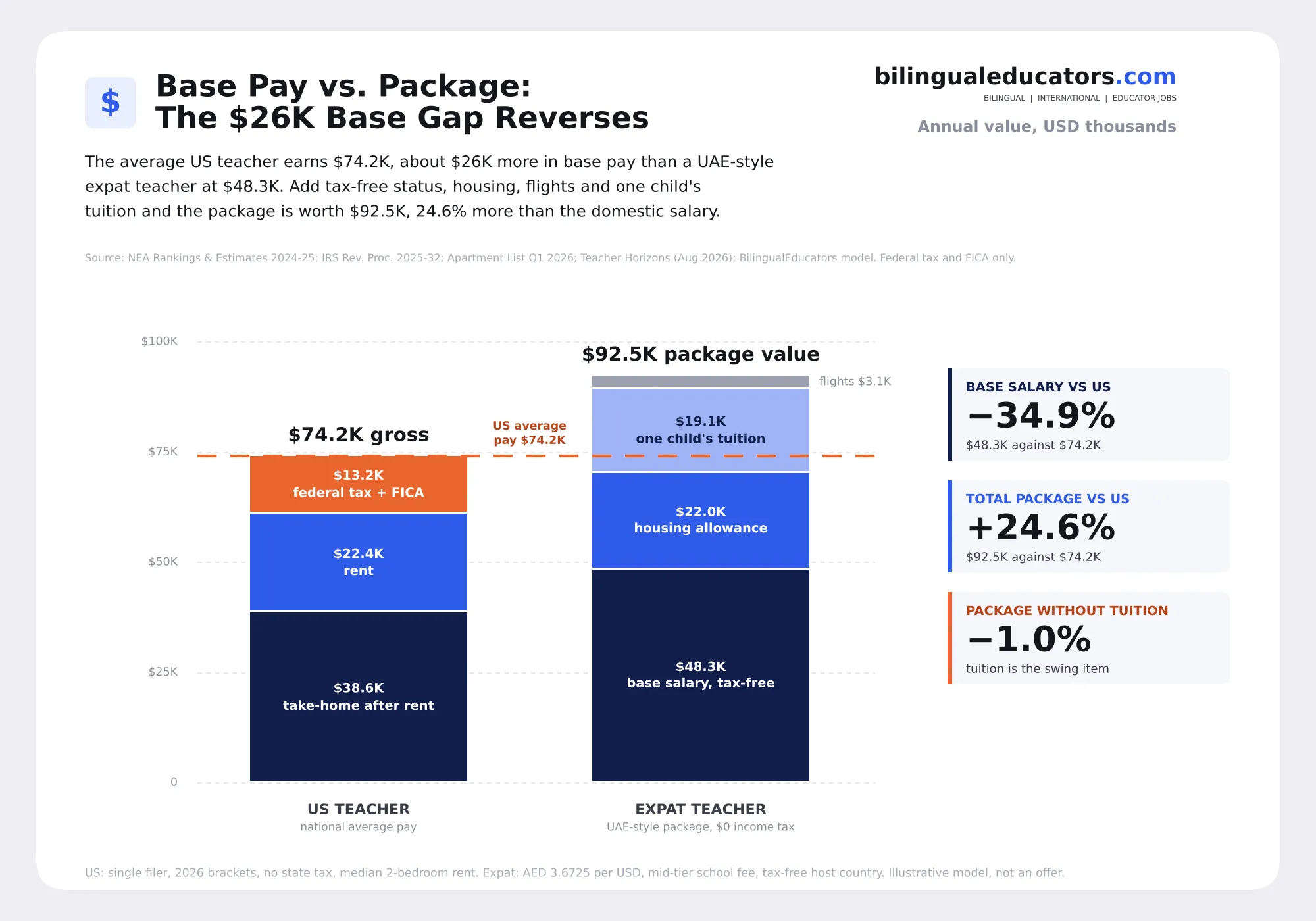
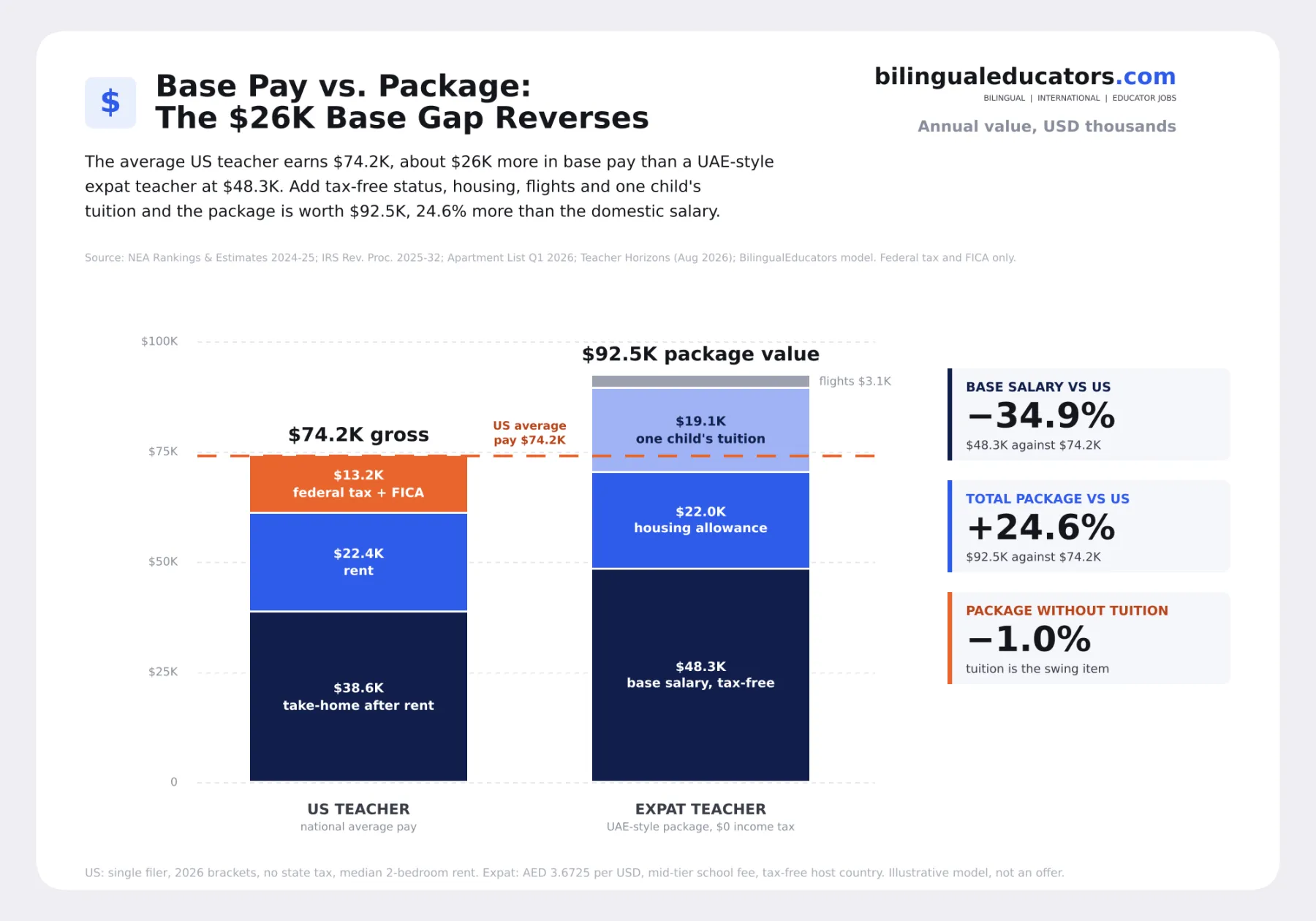
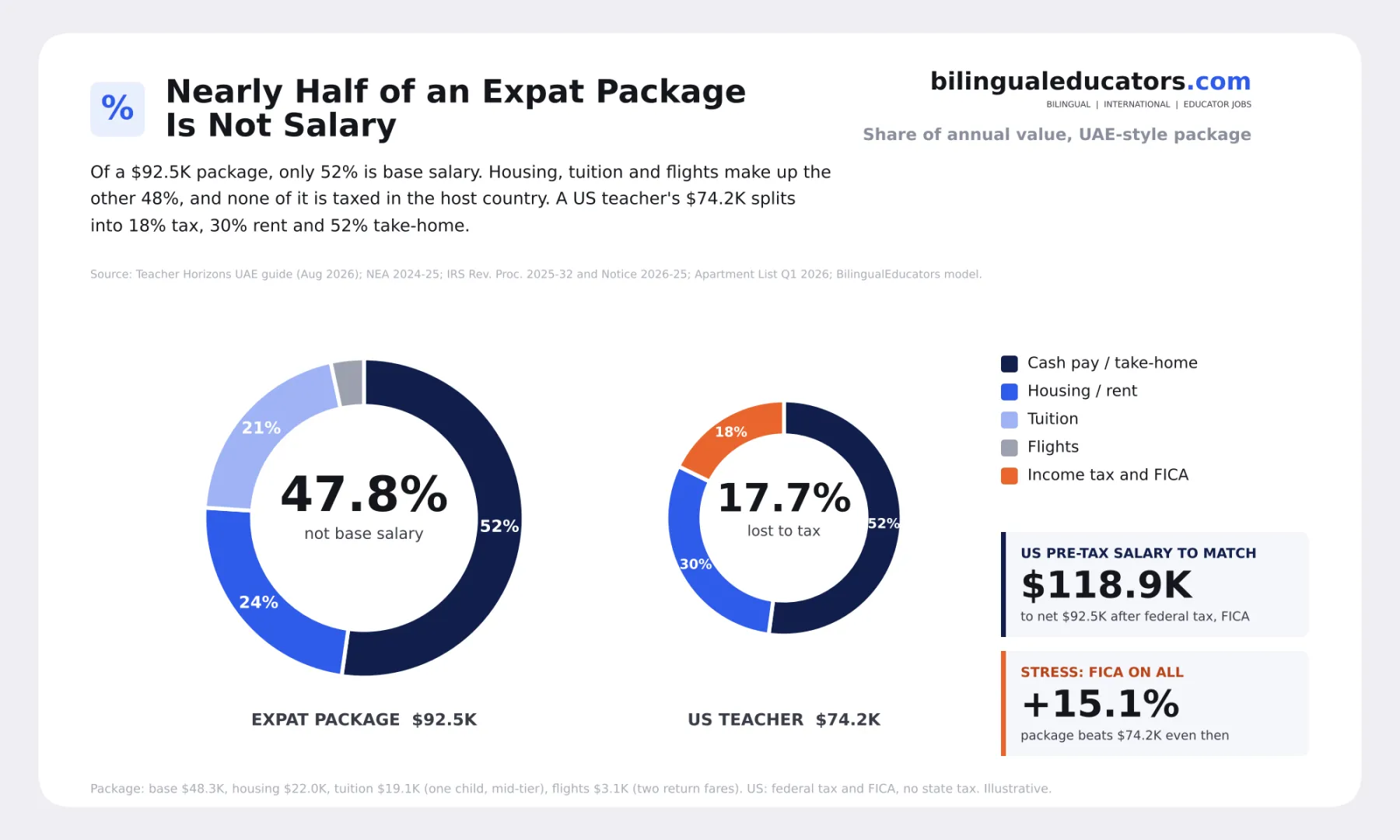
This report models one teacher in each position. The US teacher earns the NEA national average and rents a median two-bedroom at $1,865 a month, according to Apartment List's Q1 2026 report. The expat teacher earns the experienced-teacher average in the UAE and receives the package below. The housing allowance of $22,000 was set close to the US rent of $22,380 so the comparison is like for like.
Component US teacher Expat teacher (UAE-style) Base salary $74,177 $48,300 Income tax and FICA −$13,164 $0 Housing −$22,380 rent $22,000 allowance Flights home not applicable $3,100 One child's school fees $0 public school $19,060 mid-tier fee Total package value $74,177 gross $92,460 Cash left after housing $38,634 $48,300 The expat teacher's base is 34.9% lower, yet cash left after housing is 25.0% higher, and the package carries two benefits the US teacher does not receive.
What the Tax Exclusion Does
The tax effect is the cleanest part of the comparison. On $74,177, the US teacher loses 17.7% to federal tax and FICA before state tax, which would widen the gap further. The expat package loses nothing to tax in a country like the UAE.
US citizens abroad still file US returns, but the foreign earned income exclusion removes up to $132,900 of foreign earned income in 2026. The modeled package of $92,460 sits well inside that limit. The separate foreign housing exclusion starts above a base amount of $21,264 and is capped at $39,870 in most locations, so it matters mainly for higher earners or high-cost cities.
To receive $92,460 after federal tax and FICA, a US teacher would need a gross salary of about $118,900. That is the pre-tax figure that makes the two positions equal, and it is 60% above the national teacher average.
Tuition Is the Swing Factor
Tuition carries the most weight in the model and the most uncertainty.
By Teacher Horizons (August 2026), schools in the UAE commonly offer teachers discounts from 50% to free placement. Fees run from AED 30,000 to 50,000 at budget schools, AED 55,000 to 85,000 at mid-tier schools and AED 85,000 to 130,000 or more at premium schools. The International School Community puts the benefit at $30,000 to $60,000 a year per child at the top tier.
The table below shows how the package changes with the school a child attends, assuming a full fee waiver.
Scenario Tuition value Package value Versus US $74,177 No children or no benefit $0 $73,400 −1.0% One child, budget school $10,900 $84,300 +13.6% One child, mid-tier school $19,100 $92,500 +24.6% One child, premium school $29,300 $102,700 +38.4% Two children, mid-tier schools $38,100 $111,500 +50.3% For a family, the benefit is large. For a single teacher it is zero, and the package roughly matches the US salary. A US public school also costs nothing, so the honest domestic comparison for a family choosing private education is the national private school average of $13,769 a year, according to Private School Review, against a mid-tier international fee of about $19,100.
What Teachers Actually Save
Modeled packages are one thing. Reported savings are another.
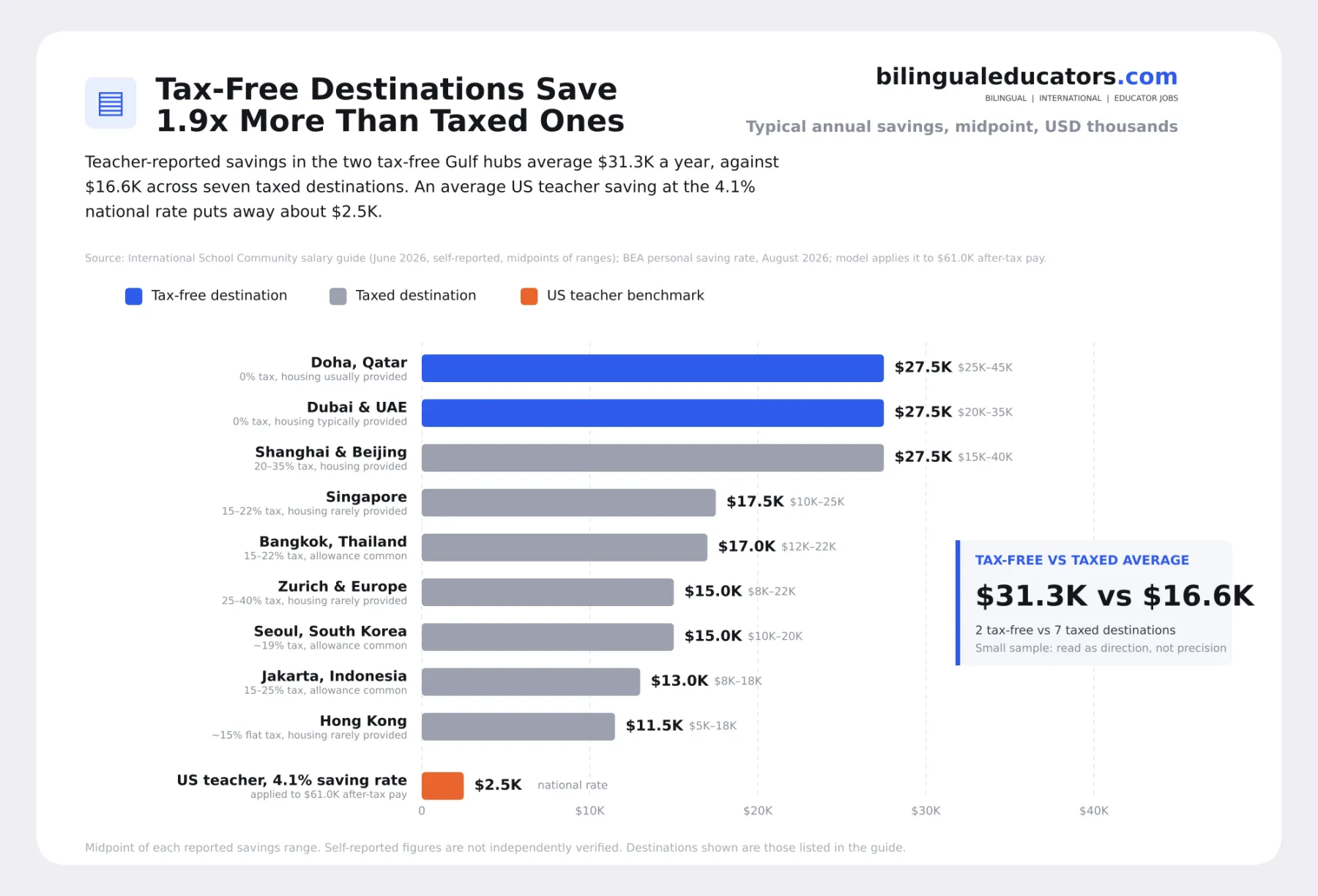
The International School Community's June 2026 guide lists typical annual savings by destination, based on teacher-submitted reviews. Doha reports $25,000 to $45,000 and Dubai and the UAE $20,000 to $35,000, both with 0% income tax. Seven taxed destinations average a midpoint of $16,600, from $11,500 in Hong Kong to $27,500 in Shanghai and Beijing. The tax-free average of $31,300 is 1.9 times higher.
Shanghai and Beijing show that tax is not the only lever. Income tax of 20% to 35% still leaves $15,000 to $40,000 in reported savings, because tier-one schools there typically provide housing. The guide says housing alone can shift net savings by $10,000 to $20,000 a year.
The US benchmark is far lower. The BEA put the US personal saving rate at 4.1% in August 2026. Applied to the teacher's $61,014 after-tax pay, that is about $2,500 a year. That is a national rate applied to an illustrative teacher, not a measured teacher savings figure.
The Entry-Level Gap Is Wider
The gap is larger at the start of a career. The UAE entry-level average is $34,700, according to Teacher Horizons. With the same housing, flights and tuition, that package is worth $78,860. The average US starting salary is $46,526, so the package is 69.5% higher.
How to Compare an Offer
The steps below are a BilingualEducators.com editorial guide based on the data above.
Price the package, not the base. Add housing, flights, tuition, insurance and any end-of-contract bonus to base pay before comparing it with a domestic offer.
Ask what is provided and what is an allowance. A school-provided home and a cash allowance are worth different amounts, and allowances in the UAE range from AED 60,000 to 150,000.
Confirm the tuition terms. Ask how many children are covered, which grades, and whether the benefit is a discount or a full waiver. This single line can move the package by $10,000 to $38,000.
Check the host country's tax rules. The Gulf is tax-free for most expats. China and many Asian hubs are not, and the savings data shows the difference.
Check your US filing position. US citizens must meet the bona fide residence or physical presence test to claim the foreign earned income exclusion, and should confirm how payroll tax applies to their employer type.
Read the Numbers With Care
This is an illustrative model, not an offer or a forecast.
The NEA figure is a national average across all experience levels. The UAE figure is the experienced-teacher average, so the comparison is not perfectly matched by seniority.
The model uses federal tax and FICA only. State tax would raise the US tax bill. FICA may not apply to a US citizen employed by a foreign school. If it applied to the whole package, the package would still be worth $85,400, or 15.1% above the US salary.
US teachers often have benefits the model leaves out: public pension plans, employer health insurance, summers off and job security. Expat packages usually include health insurance and sometimes end-of-contract bonuses, which are also excluded. Neither side includes living costs beyond rent.
The savings figures are self-reported, aggregated and unverified, and the sample of nine destinations is small. Read it as direction rather than precision. The US saving figure applies a national rate to a modeled teacher.
The tuition benefit assumes a full waiver. Many schools offer 50% discounts, and many positions cover fewer children or none.
What to Watch Next
First, tuition benefits. They are the largest and most negotiable item, and schools under cost pressure may trim them.
Second, US teacher pay. NEA's 3% rise to $74,177 was the largest in a decade. If US salaries keep rising faster than inflation, the base pay gap will widen while the package advantage depends on the dollar value of housing and fees.
Third, tax rules. The foreign earned income exclusion rose to $132,900 in 2026. Changes to it, or to host-country taxes, would move the numbers.
The data supports one clear conclusion today: for a teacher with children at a UAE-style school, a package with a base 35% below the US average is worth about 25% more, and the more of it that arrives as housing, flights and tuition rather than taxable cash, the further ahead it gets. For a teacher without children, the two are roughly equal.
Sources:
- NEA, Rankings & Estimates 2024-25 (as reported by Education Week, May 2025): average and starting teacher salaries; IRS Rev. Proc. 2025-32 (2026 brackets and standard deduction); IRS Notice 2026-25 (2026 foreign earned income exclusion, housing amounts); BEA, Personal Income and Outlays, August 2026: personal saving rate
- Teacher Horizons, UAE Teacher Salary Guide (August 2026): UAE base pay, housing, flights, tuition discounts; Tutopiya, Cost of International School in Dubai 2025-2026: fee tiers in AED; International School Community, Salary Guide 2026 (June 2026): destination salaries, tax and savings
- Apartment List National Rent Report Q1 2026 (via VerticalRent): median two-bedroom rent; Private School Review, 2026-27 tuition dataset: US private school average; BilingualEducators.com model: package comparison, AED converted at 3.6725 per USD