
Key Data
- The average US public school teacher earned $74,495 in 2024-25, and the average new teacher $48,112, according to NEA
- The median US elementary school teacher earned $62,340 in May 2024, according to the Bureau of Labor Statistics
- The 22 H-1B filings for "Dual Language Immersion Teacher" in 2024 had a median base of $65,000, with the 75th percentile at $68,966
- Bilingual stipends in a February 2026 Texas board comparison ran from $3,000 to $5,000, against a $4,570 average across 15 districts
- Suraasa's 2026 guide puts international school base pay at $36,000 to $56,000 on average globally, and total packages at $46,000 to $82,000
- Of the 12 markets charted from that guide, seven have a base range topping $68,000 and Saudi Arabia's reaches it exactly
Defining the $68K Baseline
There is no official salary for a dual-language educator. The title covers a district teacher running a 50/50 Spanish-English classroom, a Mandarin-English teacher at a private bilingual school, and an English teacher recruited by a school abroad.
The $68,000 median and the 2,400-role sample behind it come from this report's brief. The role-level dataset is not published, so this report treats $68,000 as a working baseline and tests it against public pay data.
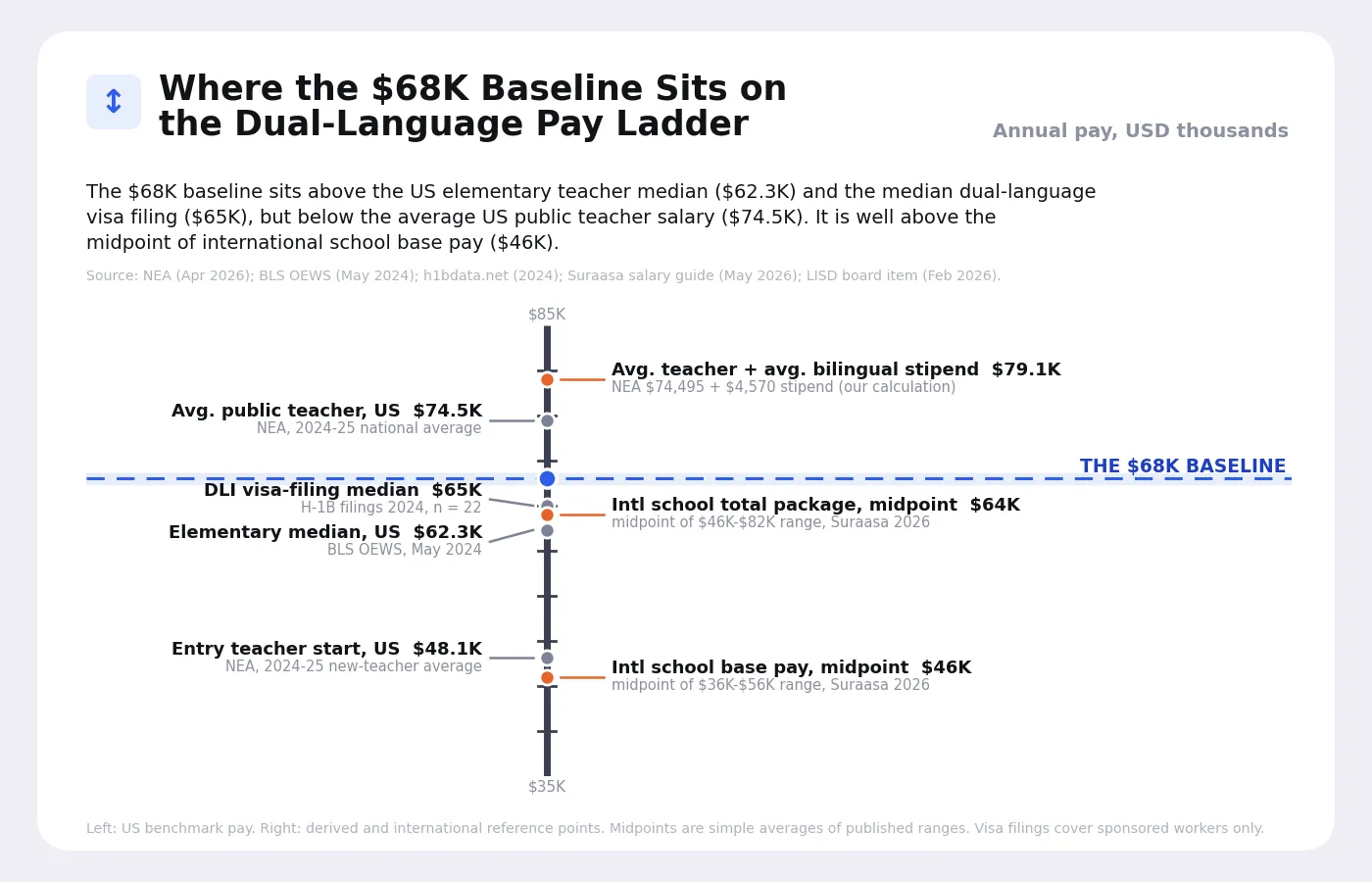
The test is encouraging. The NEA's 2026 report puts the average US public school teacher at $74,495 and the average new teacher at $48,112. The BLS reports a $62,340 median for elementary teachers. Visa records for the exact title "Dual Language Immersion Teacher" show a 2024 median of $65,000 across 22 filings, with a 75th percentile of $68,966.
So $68,000 sits about $5,700 (9%) above the elementary median, $3,000 above the median DLI visa filing and about $6,500 below the national teacher average. It is a believable mid-career figure for a domestic dual-language role. These gaps are our calculations from the sources above.
What Domestic DLI Pay Looks Like
In US public schools, dual-language teachers are paid on the same salary scale as other teachers. The bilingual premium is a stipend, and it is small.
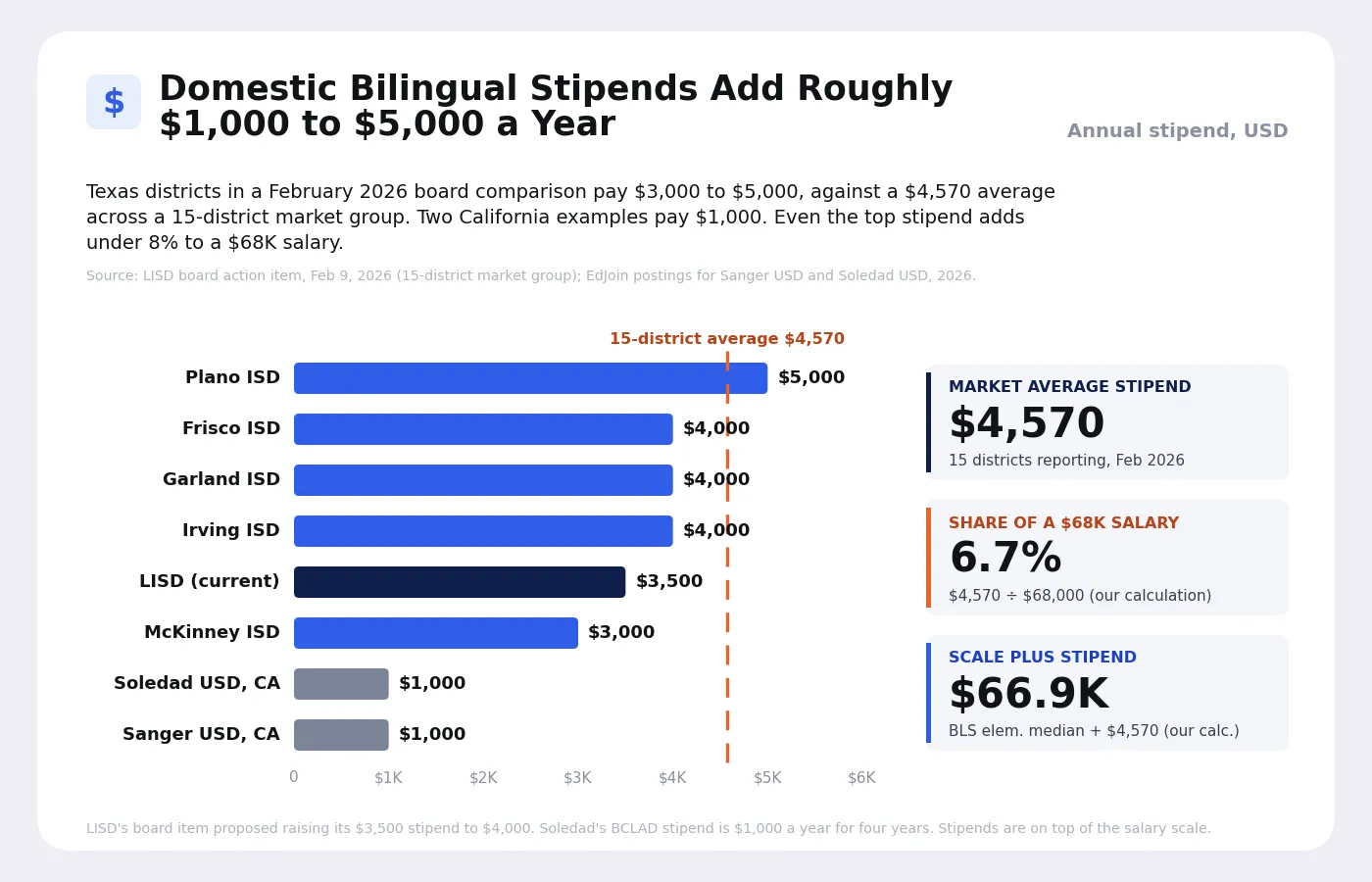
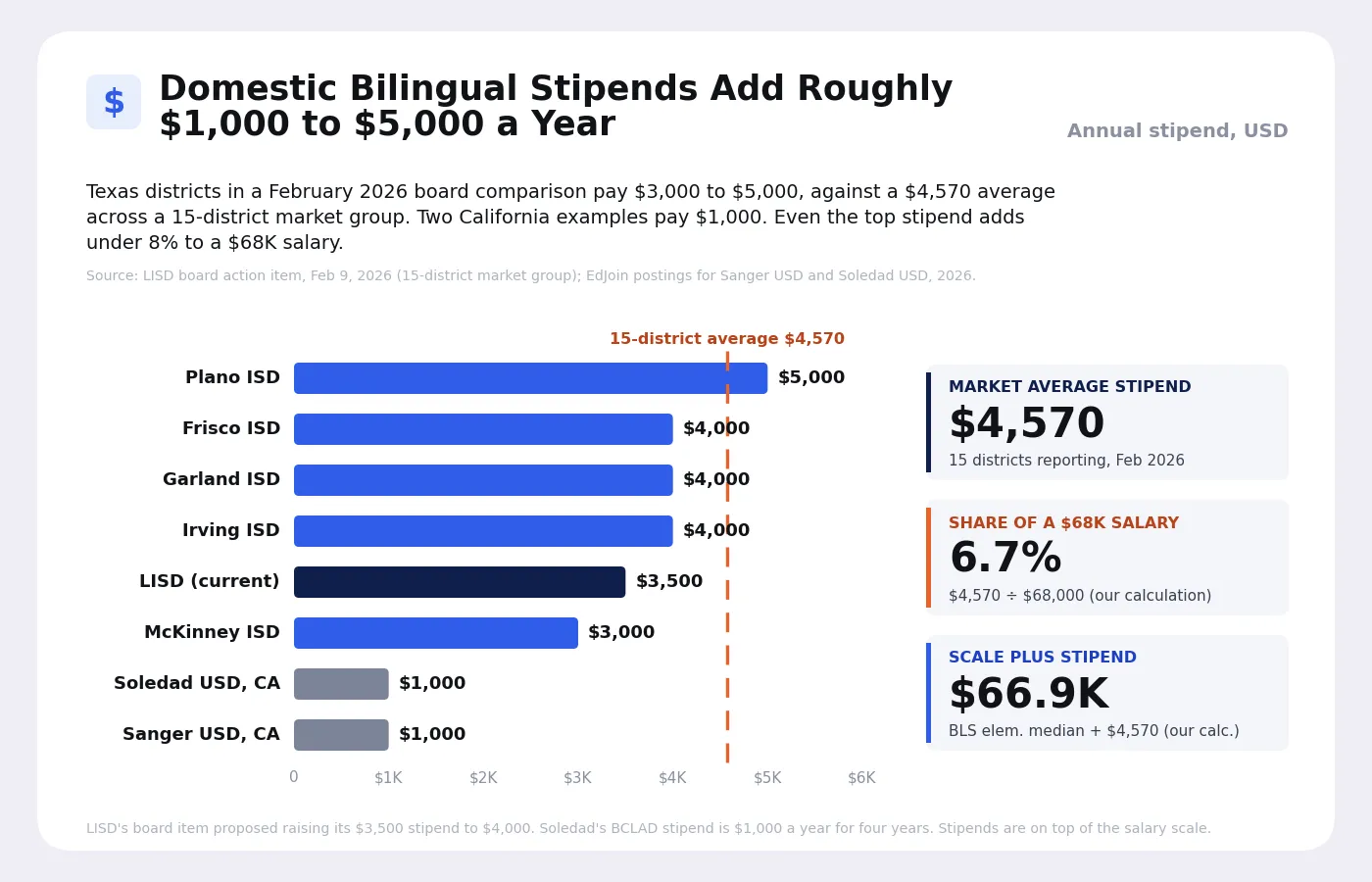
A February 2026 school board item from a Texas district identified as LISD compared its stipend to five neighbors. LISD paid $3,500. Plano paid $5,000, Frisco, Garland and Irving $4,000 each, and McKinney $3,000. The 15 districts in its market group averaged $4,570. Staff recommended raising LISD's stipend by $500, to $4,000.
California examples are smaller still. Sanger Unified lists a $1,000 dual-language stipend on its 2026-27 postings. Soledad Unified lists a $4,000 stipend for teachers holding a BCLAD certificate, paid as $1,000 a year over four years. Pajaro Valley Unified pays 3.66% of the first step of its salary scale.
Add the average Texas stipend to the BLS elementary median and the total is $66,910, about $1,100 short of the baseline. Add it to the NEA national average and it reaches $79,065. Both are our calculations. The stipend adds 6.7% to a $68,000 salary at the market average, and 7.4% at Plano's $5,000.
The base scale matters more than the stipend. A Virginia district's 2025-26 scale for a K-4 dual-language role runs from $53,000 to $82,243, with a $5,000 signing incentive for fully licensed hires. Sanger's Spanish dual-language posting runs from $64,323 to $103,841. Where a district sits on the pay scale moves total pay far more than the bilingual stipend does.
What International Bilingual Roles Pay
Abroad, the picture depends on the market and the package.
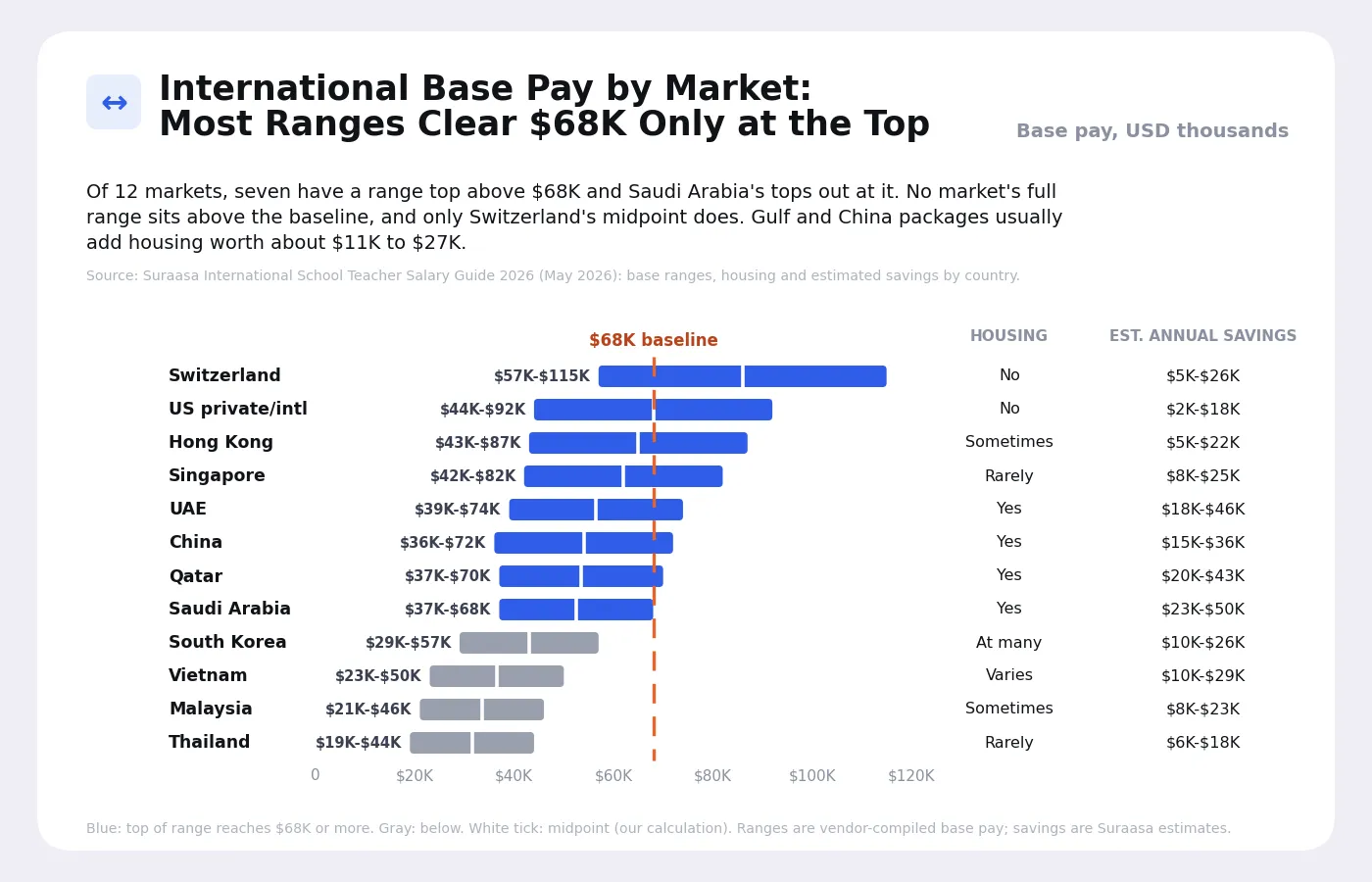
Suraasa's 2026 guide, built from its educator network and school partners, gives base ranges by country. The UAE runs from $39,000 to $74,000, China from $36,000 to $72,000, Singapore from $42,000 to $82,000 and Hong Kong from $43,000 to $87,000. Thailand runs from $19,000 to $44,000. Switzerland tops the list at $57,000 to $115,000.
Measured against $68,000, only the top end of most ranges clears it. Seven of the 12 markets we charted have a range top above the baseline, and Saudi Arabia's tops out at it. None has a range that sits entirely above it, and only Switzerland's midpoint does. Those midpoints are simple averages of the published ranges.
Global averages tell the same story. The guide puts mid-career base pay at $36,000 to $60,000 and senior base pay at $49,000 to $77,000. A $68,000 domestic salary is $8,000 above the top of the mid-career range and inside the senior range.
Packages change the comparison. The guide values housing at $11,000 to $27,000 a year, flights at $1,000 to $4,500, and tuition remission at $11,000 to $32,000 per child. A Gulf base midpoint of about $52,500 to $56,500, plus housing, lands at roughly $64,000 to $84,000 by our calculation.
Whether bilingual ability earns a premium abroad is harder to say. We found no public source that measures one. Premium school groups recruiting Mandarin-English teachers in China advertise housing, flights, medical cover and an end-of-contract gratuity, but not a salary figure. Teacher Horizons notes that bilingual schools in China face more complex regulation, and that some offer strong packages while others do not. It advises extra due diligence.
Salary Is Not the Same as Savings
The widest gap between domestic and international roles is not base pay. It is what an educator keeps.
Suraasa estimates annual savings of $18,000 to $46,000 in the UAE, $20,000 to $43,000 in Qatar and $23,000 to $50,000 in Saudi Arabia, where income tax is zero and housing is usually provided. Its estimate for a private or international school in the US is $2,000 to $18,000, for Hong Kong $5,000 to $22,000 and for Singapore $8,000 to $25,000.
Those savings figures are vendor estimates, not audited data. They still point the same way as the package data. A $68,000 domestic salary and a $55,000 Gulf base can leave very different amounts after rent, tax and flights.
The Catch: Demand Is Strong, but Pay Responds Slowly
Dual-language programs are short of teachers. The Century Foundation reports that states counted more than 440,000 English learners in bilingual programs in 2019-20, nearly 405,000 of them in dual-language immersion schools. It also notes that program administrators regularly name the limited supply of bilingual educators as the main obstacle to growth.
Pipelines are narrow. New America found that 26 states offer bilingual education certification and only Utah has created credentials specifically for dual-language teachers. A May 2026 UCLA Center for Transformative Schools report examines whether California's teacher preparation can keep pace with its DLI growth.
Yet the stipend data shows a premium of a few thousand dollars, not a step change. Visa records add a caution. The 2024 filings span $41,217 to $91,452, and the lowest salaries, at $41,217, came from a single district. The median hides a wide spread.
How Educators Can Position for the Baseline
The steps below are an editorial guide based on the data above.
Compare total pay, not the headline. A $4,570 stipend, a $5,000 signing incentive and a housing allowance worth $20,000 are not interchangeable. Total the package before you compare offers.
Check the district's scale before the stipend. Plano's $5,000 stipend matters less than whether a district's scale starts at $53,000 or $64,000.
Hold the right credential. Domestic stipends usually require a bilingual authorization such as a BCLAD. Abroad, curriculum matters. Suraasa reports premiums of 15% to 30% for IB schools and 10% to 20% for British and American curricula over a local baseline.
Ask what "bilingual school" means. In some markets the label covers premium group campuses, and in others it covers schools with thinner packages. Ask who regulates the school and what the contract includes.
Price savings, not salary. If building savings is the goal, compare tax, housing and flights before comparing base pay.
Read the Numbers With Care
The $68,000 baseline and 2,400-role sample are not publicly verifiable. Every comparison here uses public benchmarks, not that dataset.
NEA figures are averages for all public school teachers, and BLS figures cover all elementary teachers, not only dual-language roles.
Visa filings show base pay for sponsored workers. The 2024 dual-language sample has only 22 records, and the pool is not representative of all teachers.
Stipend data comes from one Texas board comparison and a handful of California postings. It does not describe every district.
Suraasa is a vendor of teaching qualifications. Its ranges and savings estimates are useful for comparison but are not independent survey data, and ranges run from entry level to senior roles.
What to Watch Next
First, stipends. If Texas districts follow LISD's proposal and raise bilingual stipends toward $4,000 and above, the market average will move up.
Second, pipelines. Residency programs and new credentials may ease the shortage, and a larger supply would soften the case for bigger premiums.
Third, international hiring. If Gulf and Asian schools keep raising packages, as Suraasa reports for Saudi Arabia, the savings gap with US roles could widen.
The data supports one clear conclusion today: $68,000 is a credible baseline for a dual-language educator in a US public school and a mid-range base offer abroad, but where the money builds is in the package and the savings, not the bilingual premium.
Sources:
- NEA, Rankings and Estimates (April 2026), as reported by NPR member stations: national average and new-teacher salaries; US Bureau of Labor Statistics, Occupational Outlook Handbook and OEWS (May 2024): elementary and kindergarten teacher medians; h1bdata.net (2024): "Dual Language Immersion Teacher" filings
- LISD board action item, "Bilingual Program Stipend Adjustments" (February 9, 2026): district stipends and market average; EdJoin postings for Sanger USD, Soledad USD and Pajaro Valley USD (2026); Virginia district dual-language teacher posting (2026-27)
- Suraasa, International School Teacher Salary Guide (May 2026): base ranges, packages, curriculum premiums and savings estimates; Teacher Horizons, Teaching in China (2026); Teach Anywhere/Randstad, Yew Chung bilingual teacher listing (China); Century Foundation, bilingual teacher pipelines; New America, dual immersion programs; UCLA Center for Transformative Schools (May 2026)